March 29, 2026
First Unitarian Universalist Society of Burlington
Reverend Karen G. Johnston, Senior Minister
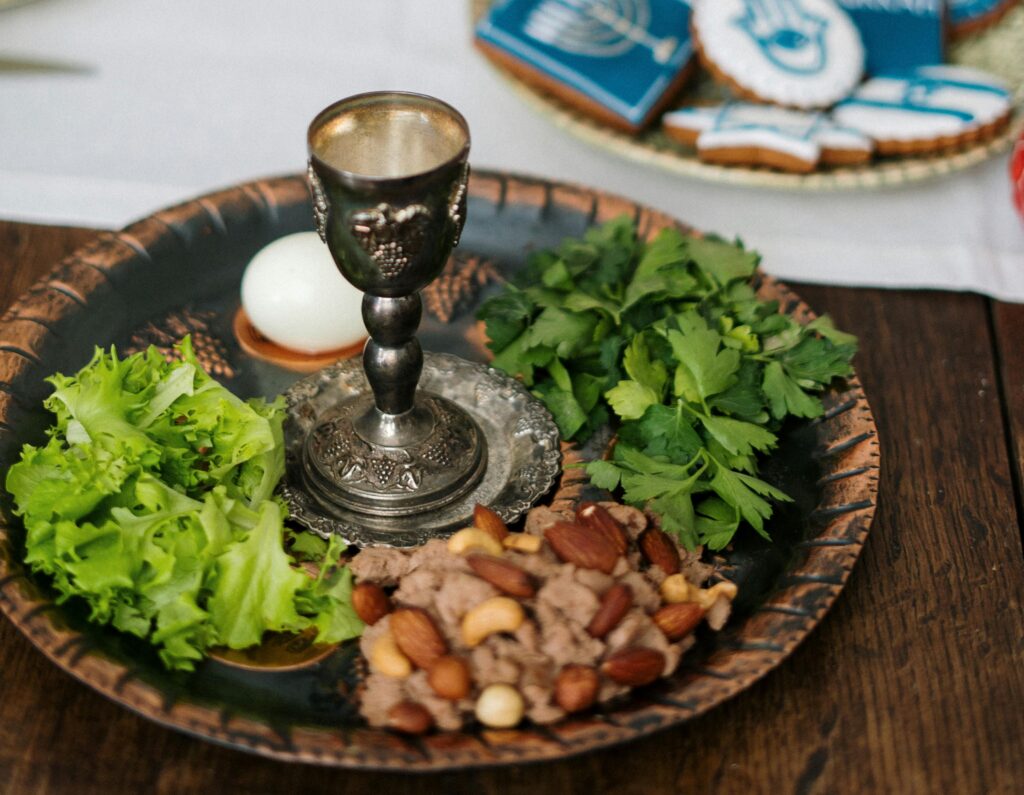
I attended my first Passover seder when I was a senior in college. It was hosted by my lefty friends, so the Haggadah – the map that guides the storytelling and rituals – they chose was not traditional. It was political: less interested in god than in a humanist collective liberation and the dismantling of all oppressions. It was fun, a bit raucous, which is why I fell in love with the holiday.
Over the years, I have attended a handful of seders – some community-based, some at the homes of friends, at least one at a UU congregation with a strong Jewish presence among its membership. I have always been thankful for the opportunity.
This year, I will be attending the community seder that the L’Chaim Collective is hosting. They are a Vermont-based Jewish community that describes itself as Judaism beyond nationalism. I appreciate that. I am appreciate this chance to be with people who want to explore the complex and sometimes confounding stories related not just to Judaism’s relationship to liberation, but to the human condition’s relationship to freedom and oppression.
This morning we heard two stories related to Passover. One was a summary of the holiday. The other, a midrash for our Time for All Ages, using our moral and mystical imagination to fill in the gaps left in ancient scripture: the Red Sea having agency and choosing to side with liberation. Definitely, a mystical take on that ancient story.
We need not be Jewish to be inspired by Passover. And as Unitarian Universalists, our core value of Pluralism, supports this.
So, I pose this question: what it would mean for each of us, if we allow ourselves to be inspired by our understanding of the Passover story and guided by our UU Value of placing Love at the Center?
As you can tell by the recurring topic of some of my sermons, I am spiritually preoccupied with what my purpose is in these perilous times. Maybe this is also a preoccupation for you, too.
Given my role as your Senior Minister, I engage this question out loud. Hopefully, I do it not AT you, but WITH you: here from the pulpit, to be sure, and also in group discussions, private pastoral conversations, and sometimes in the streets.
As I reflect on the Passover story, it’s clear who the hero or good guys are. Moses. Those who help Moses. Those who follow Moses. As such, we are meant to identify with them: those fleeing oppression and slavery, innocent and undeserving of being enslaved, and their leader.
But here’s the thing: we who are United States citizens, given who is in charge of our government, we are not the Moses character in this story. We are Pharaoh. Or, at least, Pharaoh’s people. Including that master who was whipping a slave.
Well, hopefully not anyone here – in the room or the livestream. But it’s hard not to acknowledge that in ever more increasing ways, we are living in Pharaoh’s land. We are in the midst of our own government making choices, using its resources for oppression. The Department of Homeland Security buying up properties for huge detention centers – folks who will be held in these warehouses will not have their freedom. Our own government is not only de-centering Love, but throwing it to the curb.
What is ours to do – being a citizen under Pharaoh’s rule – when there are people we know and many we don’t, who experience the oppressive yoke of our nation?
This is why I return, over and over again, to the topic of resistance. For if I am to live in Pharaoh’s land, I do not want to be the master whipping the slave. Or complicit with such a heinous act. I want to be Moses’ ally – perhaps Pharaoh’s daughter who saves the Jewish child from her father’s order to kill all the Jewish first-born sons; or the Red Sea mysteriously parting to ensure those being hunted can escape.
Last summer, when visiting my younger daughter in Germany, I went to Berlin, where I had lived during the summer of 1987. In August, I shared a bit about this trip in a sermon here. My time in Berlin included what one might call a kind of pilgrimage because I went there with a great need.
I knew stories of resistance by Jewish people being hunted by the Nazis – such as the nearly one hundred other examples of armed resistance in occupied Poland and the Soviet Union, the Warshaw Uprising being the most widely-known of these. I knew stories of resistance and sabotage by those in occupied lands – France, Holland, Norway. I knew a few of the more famous acts of resistance against Hitler from within – Sophie Scholl and die Weiẞe Rose / the White Rose movement in Munich; the 1944 assassination attempt of which Christian theologian, Dietrich Bonhoeffer was a part and for which he was executed.
I know there were plenty – too many – of Germans who actively participated and there were too many who passively participated. That is a reality we know all too well and I have no intention of minimizing it. Nor do I want our current context to repeat it.
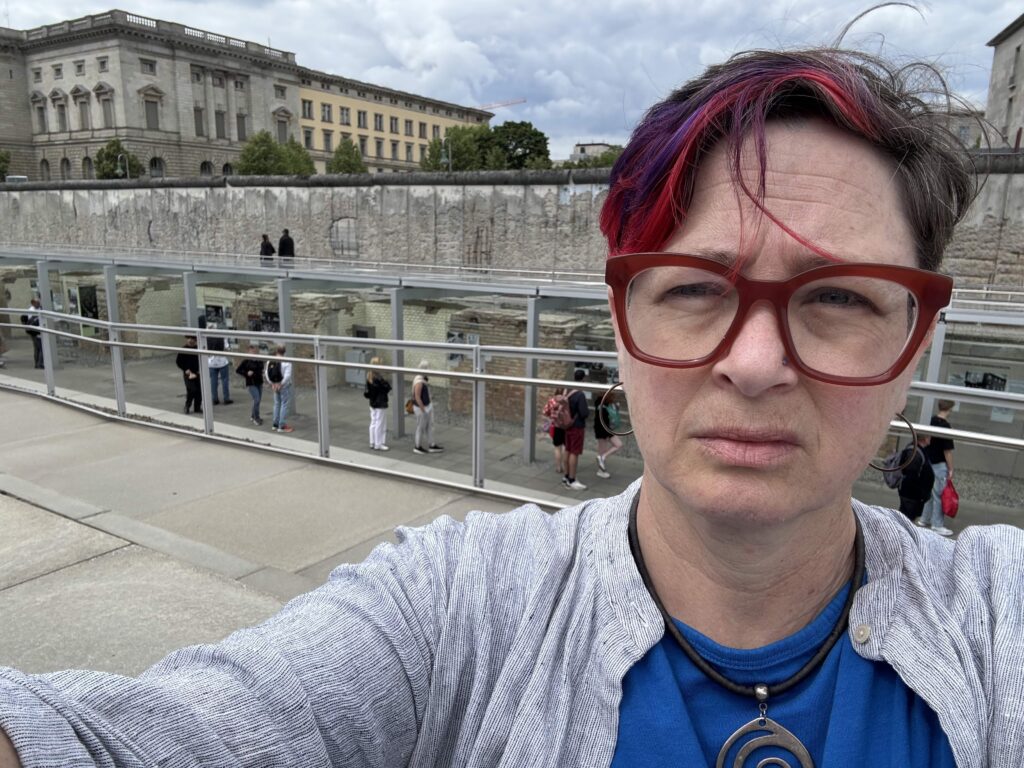
I had a great need to know about resistance from within the non-Jewish German population. I had (and HAVE) a great need to know that there are ethical ancestors whose stories I can call on, given my social and political location, as a citizen of this nation, as a resident in Pharaoh’s land.
Yes, Pharaoh’s land. Last week, National Public Radio reported that this month three major reports were issued – one international and two based in the US – declaring measured, serious damage to American democracy. The report from an institute at the University of Gothenberg in Sweden lowered America’s democracy ranking from 20th out of 179 to 51st. Freedom House, based in the US, reports that freedom globally has declined for the 20th consecutive year and that this year, the US, along with Bulgaria and Italy, experienced the most drastic declines. Yes: Pharaoh’s land.
So, yes, last year, I felt a great need to know more about non-Jewish Germans and the resistance they mounted (or didn’t mount) with the rise of national socialism in the 1930s and early 40s. This need emerged because around me, people were talking about leaving or staying in this country.
My great need to know these stories came from my wish for another way to ground my courage. And I have thought that we, as a community, might have this same need to learn about people similar to us – regular folx with whom we could identify; in which we could see ourselves.

Here pictures of real people – non-Jewish Germans from the late 1930s and early 40s — who were a part of organized circles protecting their neighbors. They come from the Berlin museum called the Topography of Terror.
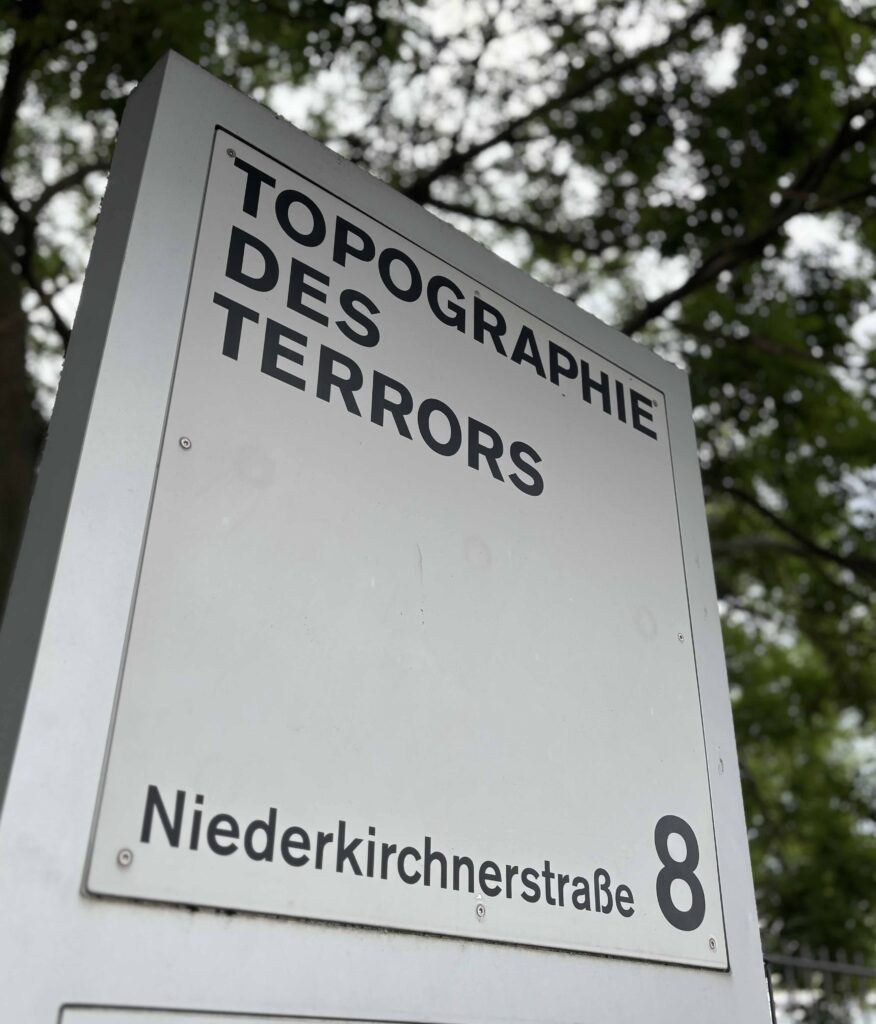
Protecting their neighbors. Sound familiar? Hiding them. Feeding them. Helping them safely get medical care. Helping them leave to gain safety. Pictures of non-Jewish German people who did not or could not leave, yet chose to quietly gum the machine, at no small risk to themselves. People who chose to go against the stream and part the waters in hopes that those being targeted for oppression would find freedom.
Look at their faces. Even in these mug shots, taken at an extremely distressing time, having been found out and arrested, you see their humanity. Perhaps you can see commonalities we might have with them. Do you notice
- how they are different ages, spanning several generations?
- how human they are, with messy hair or perfectly coiffed?
- how they seem to come from different classes across society?
- how some of them show the evidence of having been roughed up?
When I look at them, I can’t help but see the resemblance of those who were there on Dorset Street on March 11th, surrounding that home with a chain of love and determined defense.
A word about those last five people. They were part of a loosely-knit group of what turns out was at least 400 individuals – perhaps more, but four hundred is what history has retained – in a multiplicity of resistance groups, connected through personal contacts, uniting hundreds in opposition to the Nazi regime.
Some were in Berlin but not only Berlin. They held discussions, printed and distributed leaflets, posters, stickers, hoping to support, inspire, incite sabotage and resistance. They aided targeted individuals – Jews, fellow resisters – to escape when necessary. They documented atrocities (long before cell phone cameras). They even transmitted military intelligence to the Allies.
In Berlin, they called themselves “The Circle” but were given a name by the Nazis – “die Rote Kapelle/the Red Orchestra” – one that associates them as being under the auspices of the Soviet Communists, but that was part of a larger smear campaign that had no basis.
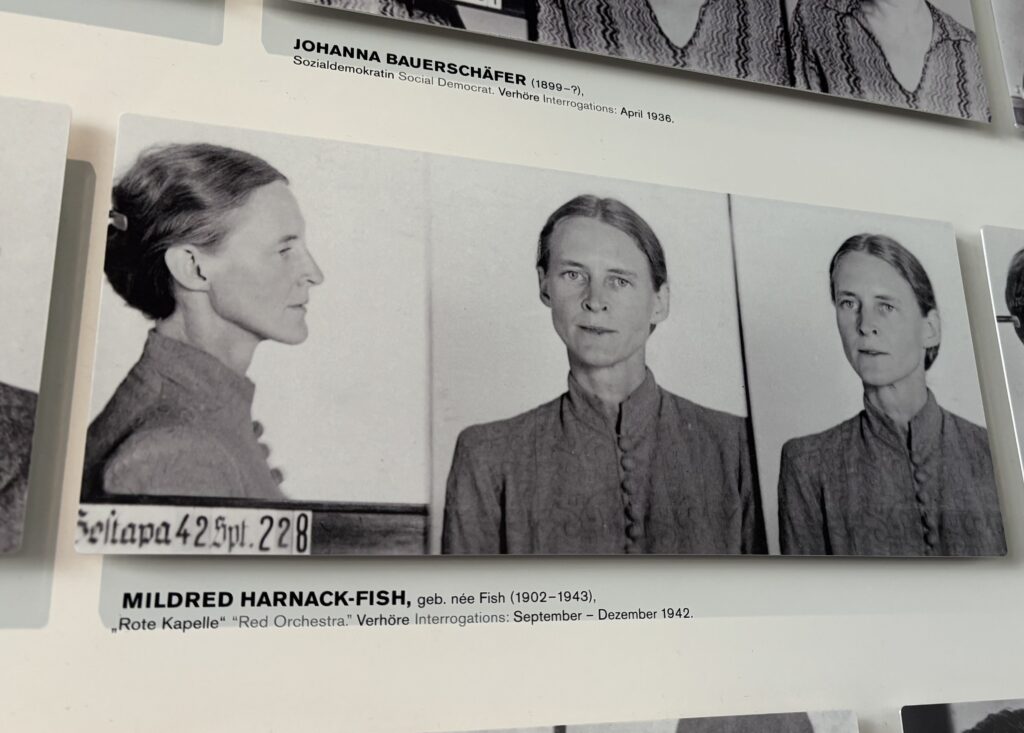
That last person? Her name was Mildred Harnack-Fish. She was an American. One who was strongly influenced by Ralph Waldo Emerson and Walt Whitman. Originally from Wisconsin, she met and married a German man – Arvid Harnack. They moved to Germany together in 1928. Mildred was executed for her resistance activities; so was Arvid. Mildred the only American to be killed based on Hitler’s express order.
These days, we all need our courage rekindled. Rekindled, reminded, reimagined.
Encouraged. Not co-raged, but like the French etymology. Cour: of the heart. That whole love at the center thing.
I find that I need to be encouraged, over and over again, so that I can be a part of a larger collective, seeking, creating, fostering, insisting upon freedom from oppression and liberation from tyranny even as we are residents and citizens, of a nation that deepens it determination to foment war and violently demean groups of people – immigrants, transgender folx – in our name.
We need to be en-courage-d as we go on living here in Pharaoh’s land, with an administration made of a cadre of sycophants with hardened hearts and not a single plague, much less ten of them, in sight.
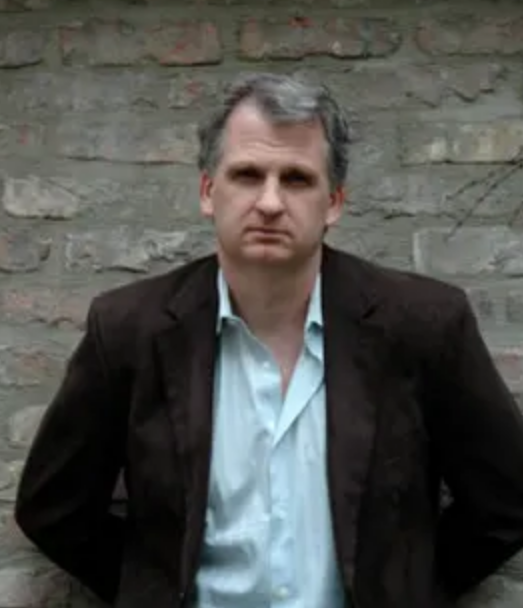
Remember the guidance written by Professor Timothy Snyder? He’s one of the people who left the U.S. for safety and continues to communicate from Canada his ideas on how we Americans can respond and resist authoritarianism in our midst.
Perhaps each one of these ten exhortations, from a list of twenty published in his book, On Tyranny, is a modern-day plague that we are called to embody:
1. Do not obey in advance.
2. Defend institutions.
5. Remember professional ethics.
6. Be wary of paramilitaries.
11. Investigate.
12. Make eye contact and small talk.
13. Practice corporeal politics.
16. Learn from peers in other countries.
18. Be calm when the unthinkable arrives.
20. Be as courageous as you can.
Yes, be as courageous as you can. As we can.
Yes, be as encouraged as you can. As we can.
Choosing, over and over again, to tell all the tyrants to let our people go.